
Skin Tag Removal
Remove other unwanted skin growths quickly and safely.
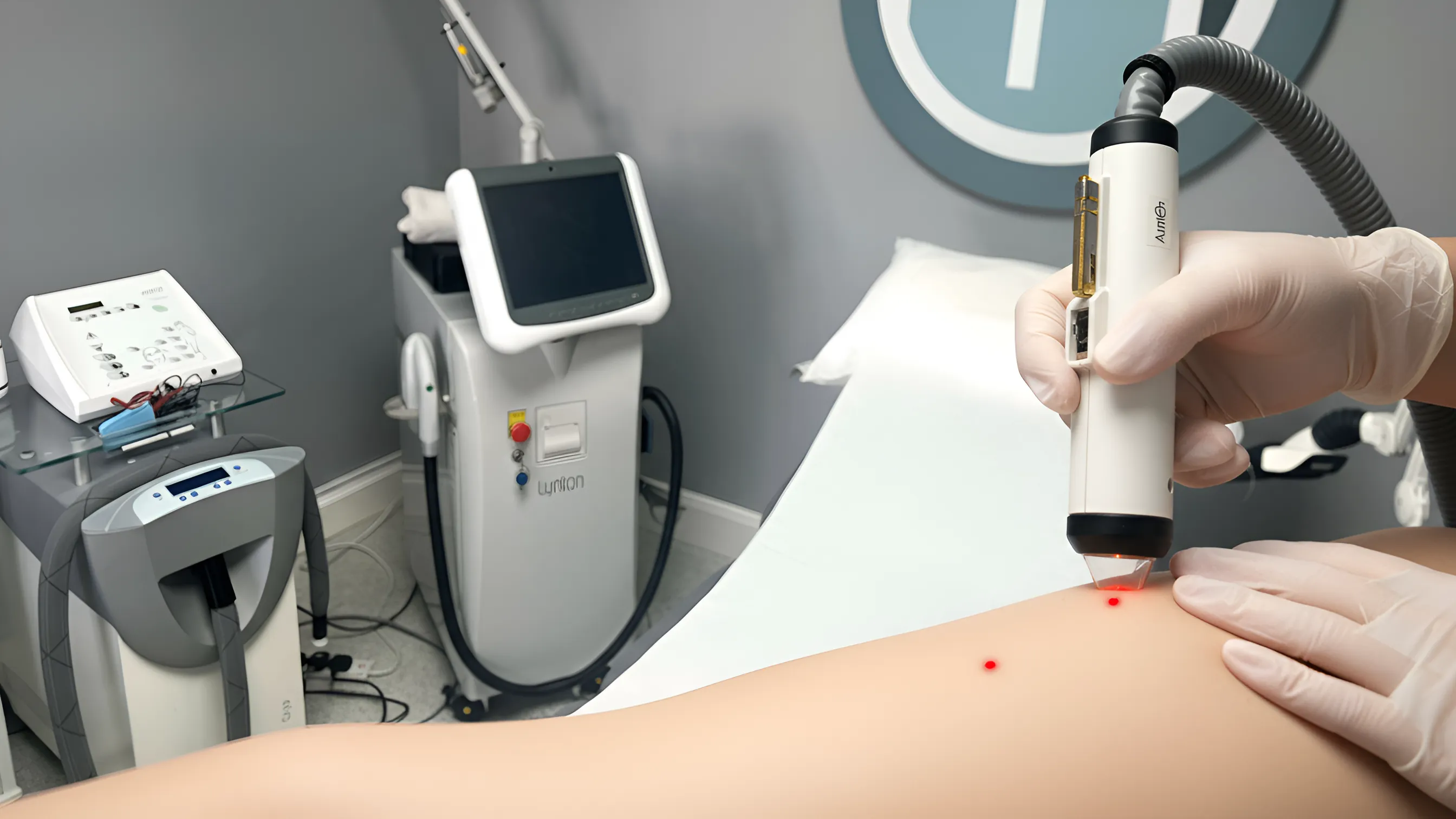
Campbell de Morgan spots, also known as cherry angiomas, are small red raised spots that commonly appear on the torso. Though harmless, they can be a cosmetic concern. Kathryn removes them quickly using IPL and laser treatment.
 Best Results
 1-3 Treatments
 Treatment Time
 15-30 Minutes
 Recovery
 24-48 Hours
 Complications
 Very Low
 Anaesthetic
 Not Required
 Cost
Cost From £60
Initial consultation required first
Before booking this treatment you'll need an initial consultation, so Kathryn can assess your suitability and keep your treatment safe. The £35 consultation fee is credited toward your first treatment. Book your consultation below.
Started noticing little red dots appearing on your body that weren't there before? You might have dismissed the first few, but now they seem to be multiplying. They're on your chest, your stomach, maybe your back. You've probably Googled them (and scared yourself) before discovering they're called Campbell de Morgan spots or cherry angiomas—and they're completely harmless.
Campbell de Morgan removal uses laser treatment to eliminate the cherry-red angiomas that commonly appear on adult torsos. The LUMINA® laser coagulates the dilated capillaries forming these benign spots, which your body absorbs over 4-8 weeks. Most spots disappear after 1-3 treatments.
Campbell de Morgan spots are one of the most common benign skin growths in adults. Named after the 19th-century British surgeon who first described them, they're also known as cherry angiomas because of their bright cherry-red colour. They're essentially small clusters of dilated capillaries—tiny blood vessels that have formed into visible red spots on your skin's surface.
Understanding Campbell de Morgan Spots:
These spots have distinctive characteristics that make them easy to identify:
• Appearance — Bright red, cherry-coloured spots that range from pinpoint size (1-2mm) to larger growths (up to 5-6mm). They're usually round or oval.
• Texture — They start flat but often become slightly raised over time. The surface may feel smooth or have a slightly rubbery texture.
• Colour — Bright red to deep burgundy, depending on depth and blood flow. Some may appear purple.
• Blanching — They briefly fade when pressed, then fill back with blood—a characteristic of vascular lesions.
Where They Typically Appear:
While Campbell de Morgan spots can appear anywhere, they have favourite locations:
• Trunk — The most common area, including chest, stomach, and sides.
• Back — Particularly the upper back.
• Arms and shoulders — Often in sun-exposed areas.
• Thighs — Upper thigh area is fairly common.
• Face — Less common but can occur.
They rarely appear on hands, feet, or mucous membranes.
Why Campbell de Morgan Spots Develop:
The exact cause remains unknown, but several factors are associated with their development:
• Age — They become increasingly common after age 30, with most adults developing at least a few by middle age. Some estimates suggest up to 75% of people over 75 have them.
• Genetics — If your parents had cherry angiomas, you're more likely to develop them too. There's a strong hereditary component.
• Hormones — Pregnancy seems to trigger or increase their development in some women.
• Climate and environment — Some studies suggest they may be more common in certain climates.
• Chemical exposure — Exposure to certain chemicals has been linked to increased cherry angioma development, though this is relevant mainly for occupational exposure.
Are They Dangerous?
Campbell de Morgan spots are completely benign—they're not cancerous and won't become cancerous. They don't spread or cause health problems. The only reasons to treat them are cosmetic: if they bother you, you don't have to live with them.
However, it's important to distinguish cherry angiomas from other red spots that might need medical attention. If a red spot is irregular in shape, varies in colour, bleeds without trauma, or changes rapidly, it should be assessed by a medical professional. Kathryn at Mode Laser Skin Clinic will confirm that your spots are indeed harmless cherry angiomas before any treatment.
How Laser Treatment Works:
Mode Laser Skin Clinic uses the LUMINA® laser to treat Campbell de Morgan spots. The treatment works through selective photothermolysis—the laser's specific wavelength is absorbed by the blood in the dilated vessels. The laser energy converts to heat. Heat damages the vessel walls, causing them to collapse.
• The blood coagulates and the vessels collapse
• Over weeks, your body absorbs the damaged tissue
• The spot fades and eventually disappears
What you'll see: Immediately after treatment, the red spot turns grey or dark. This is the coagulated blood and damaged tissue. Over the following 4-8 weeks, your body's natural processes clear this away and the spot fades from view.
Treatment Variables:
Several factors affect how many treatments you'll need:
• Spot size — Small spots (1-2mm) often disappear after one treatment. Larger spots may need 2-3 sessions.
• Spot thickness — Flat spots respond faster than raised ones.
• Number of spots — Multiple spots can be treated in one session, but very numerous spots might be staged across appointments.
• Location — Some areas respond faster than others.
Most clients see excellent results within 1-3 treatments spaced 8-10 weeks apart.
Treatment Alternatives:
While laser is the most common treatment at Mode Laser Skin Clinic, other options exist:
• Electrocautery — Uses electrical current to destroy the vessels. Effective but may cause more surface trauma.
Kathryn will recommend the most appropriate method for your specific spots.
Living with Campbell de Morgan Spots:
If you choose not to treat them, cherry angiomas are perfectly safe to leave alone. They don't require monitoring unless they change (which would warrant assessment). Some people simply accept them as part of aging.
However, if they bother you—whether that's a single prominent spot on your chest or dozens scattered across your torso—treatment is straightforward, effective, and permanent for those specific spots. New ones may develop over time, but treated spots don't return.
Kathryn's Experience:
With 20+ years of laser experience at Mode Laser Skin Clinic, Kathryn has treated hundreds of cherry angiomas. She'll assess your spots during consultation, confirm they're appropriate for treatment, explain what results to expect, and carry out treatment with the precision that comes from extensive experience.
The exact cause is unknown, but they're very common and tend to appear more frequently as we age. They're completely harmless but many people choose to have them removed for cosmetic reasons.
Most spots respond within 1-3 treatments. Small spots may disappear after just one session, while larger or more numerous spots may need additional treatments spaced 8-10 weeks apart.
The treatment is mildly uncomfortable, though sensations vary among individuals. Cooling is used during the treatment to help reduce any discomfort. Most clients tolerate it very well.
The red spots will turn grey immediately after treatment. Over the following weeks, they're naturally reabsorbed by your body and fade from view. Some temporary redness or mild swelling is normal.
Immediately after the laser, the treated area may temporarily whiten—an expected instant skin reaction that usually lasts only a few minutes. The area may also feel warm, slightly red, or tender, with minor swelling, bruising, or crusting, and scabs or flakes may form, which should not be picked. The ink itself does not change instantly; fading occurs gradually over multiple sessions, and proper aftercare helps ensure safe healing and optimal results.
Wear SPF 30+ sunscreen daily and avoid sun exposure for at least 4 weeks prior to treatment. A patch test will be carried out at your consultation to confirm suitability.
If any of these sound familiar, this treatment could be right for you.
Red dots appearing on your body that seem to multiply over time
Cherry angiomas are easily treated with laser—one session removes most spots
Self-conscious about the spots when wearing swimwear or low-cut tops
Treatment removes visible spots, restoring your confidence at the beach or gym
Unsure whether your red spots are harmless or something to worry about
Kathryn will assess your spots during consultation and confirm they're suitable for treatment
Spots on your chest or torso that you'd rather not have
Laser treatment causes spots to fade naturally over weeks—they don't return
Kathryn will examine your Campbell de Morgan spots, assess how many you have, and explain what results to expect. A patch test confirms your skin's suitability for treatment.
Avoid sun exposure for 6 weeks before treatment. Wear SPF 30+ daily. Arrive with clean skin—no products on the treatment area.
The laser is applied to each spot. You'll feel mild warmth and a snapping sensation—cooling is used for comfort. Treatment takes 15-30 minutes depending on how many spots are treated.
Treated spots will turn grey immediately—this is expected. You may have temporary redness or mild swelling. The grey colour fades over the following weeks as your body absorbs the treated tissue.
Spots fade gradually over 4-8 weeks. Some disappear after one treatment; others need 2-3 sessions spaced 8-10 weeks apart. Once gone, those specific spots don't return.
Not sure if your red spots are Campbell de Morgan spots? Even if you think they're harmless, proper identification matters. Without professional assessment, you risk missing something that needs medical attention. Kathryn will assess them during a consultation and confirm whether laser treatment is appropriate.
Many Campbell de Morgan spots disappear completely after just one laser session at Mode Laser Skin Clinic. Even larger or multiple spots typically require only 2-3 treatments. Each session is quick—15-30 minutes depending on how many spots are treated—making it easy to fit into your schedule. Finally, you can address those red dots that have been multiplying for years.
The LUMINA® laser includes integrated cooling to protect your skin and ensure comfort during treatment. Most clients describe the sensation as a mild snapping with slight warmth—very tolerable. There's no need for anaesthesia for most cherry angioma treatments. Even if you're concerned about discomfort, most clients are pleasantly surprised.
After treatment, your body does the work. The laser causes the spots to turn grey as the vessels collapse, then over 4-8 weeks your natural immune processes clear away the treated tissue. The spots fade gradually and naturally—no dramatic overnight change that prompts questions. The treated tissue is absorbed. Absorbed tissue leaves behind clear, spot-free skin.
Campbell de Morgan removal is a straightforward, low-risk procedure. Most clients experience nothing more than temporary redness at the treatment site. Complications are rare, and serious side effects are extremely uncommon when treatment is performed by an experienced practitioner like Kathryn.
You can return to normal activities immediately after treatment. There's no bandaging, no recovery period, no restrictions on showering or exercise. The treated spots may look grey initially, but you can carry on with your day as normal.
Those red dots that made you self-conscious at the beach, at the gym, or in intimate situations—gone. Many clients at Mode Laser Skin Clinic report significant improvement in confidence after treatment, feeling comfortable wearing lower-cut tops, going to the pool, or simply looking in the mirror without counting new spots.
Remove other unwanted skin growths quickly and safely.
Treat visible blood vessels on the face and body.
Address age spots and uneven skin tone.
Learn about our LUMINA® laser technology.
View before and after photos.
See why patients rate Mode Laser Skin Clinic 5 stars on Google. Book your consultation.
Mode Laser Skin Clinic — Based within Essington Clinic